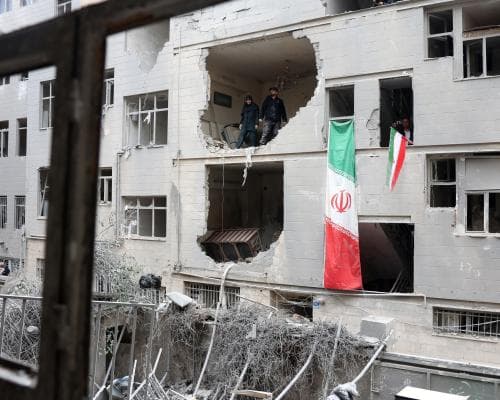
This blog is closed. Our live coverage continues here: This blog is about to close but we’re continuing our live updates from the US-Israel war on Iran in a new live blog, which will include a recap of the latest key developments. Thanks for reading. Iran’s foreign minister has argued Israeli strikes on fuel depots across Tehran amount to “ecocide”, citing the impact on the health of the Iranian capital’s residents. “Israel’s bombings of fuel depots in Tehran violate international law and constitute ecocide,” Abbas Araghchi wrote on X. “Residents face long-term damage to their health and well-being. Contamination of soil and groundwater could have generational impacts.” Israel “must be punished for its war crimes”, he added. Donald Trump is said to be working to build a coalition of countries that will attempt to reopen the strait of Hormuz. The US president hopes to unveil the list later this week, Axios reported, citing four unnamed sources. Over the weekend, Trump claimed that “many countries” would send warships to the region – before publicly urging a string of countries to do so. The response has been muted, my colleague Hannah Ellis-Petersen reported from Dubai. Japan has said it will not send warships “at the moment” to help reopen the strait of Hormuz, after Donald Trump urged countries to join a “team effort” to protect vessels from Iranian strikes. The strait has been all but closed since the start of the war, raising fears for energy supplies. A fifth of global oil supplies typically pass through. The US president repeatedly pressed countries to help secure the waterway this weekend – specifically naming China, France, Japan, South Korea and the UK – and earlier warned that Nato faces a “very bad” future if its members fail to step up. “In the current Iran situation, we are not at the moment considering issuing a maritime security operation,” Japanese defence minister Shinjiro Koizumi told the country’s parliament. In the UK, ministers are drawing up plans to send minesweeping drones to the strait, my colleague Kiran Stacey reported earlier, amid concerns in Whitehall that complying with Trump’s demand to send ships could escalate the crisis. Australia has also confirmed it will not send ships. “We know how incredibly important that is, but that’s not something we’ve been asked, or we’re contributing to,” transport minister Catherine King told national broadcaster ABC. The fire near Dubai’s international airport is contained, according to authorities. “Dubai Civil Defence teams confirm that the situation remains under control, with no spread of the fire,” Dubai’s media office said in a statement. “No injuries reported.” Flights were suspended from the airport a short time ago. Iran has arrested 500 people accused of sharing information with enemies, the Islamic Republic’s police chief has said. Half of those cases had involved serious incidents “including people who provided information for hitting targets and individuals who took footage of strike locations and sent them”. Ahmadreza Radan said on Sunday, without going into detail on when the arrests took place. Reuters also reports that earlier, while Israeli and US strikes continued on new targets in the country, Iranian media said dozens of arrests had occurred in several regions on Sunday. In north-western Iran, the semi-official Tasnim news agency said, 20 people were arrested on accusations by the provincial prosecutor’s office of sending location details on Iran’s military and security assets to Israel. In north-eastern Iran, which has remained relatively untouched by airstrikes, Tasnim reported the arrest of 10 people, with some accused of collecting information on sensitive locations and economic infrastructure. The Student News Network said three people were detained in the western province of Lorestan for “seeking to disturb public opinion ... and burn mourning symbols”. Israel has begun targeting security checkpoints based on tip-offs from informants on the ground, representing a new phase of its assault on Iran, a source briefed on Israel’s military strategy told Reuters last week. Dubai authorities have temporarily suspended flights at the city’s international airport after a “drone incident” caused a fire in the area. The Dubai media office said a little earlier that Dubai civil defence teams had contained the fire, which resulted “from impact to one of the fuel tanks” in the vicinity of the airport. The office later posted on X: Dubai Civil Aviation Authority announces the temporary suspension of flights at Dubai International Airport as a precautionary measure to ensure the safety of all passengers and staff. Travellers are advised to contact their respective airlines for the latest updates regarding their flights. Further updates will be announced through official channels as soon as they become available. Emirates posted that all the airline’s flights to Dubai had been “temporarily suspended”, also saying: Please do not go to the airport. Emirates will share updates when available. French president Emmanuel Macron says he has told his Iranian counterpart Masoud Pezeshkian it is “unacceptable” to target French interests, after an Iranian-designed drone killed a French soldier in Iraq’s Kurdistan region. Macron said on X after his call with Pezeshkian on Sunday: I called on him to put an immediate end to the unacceptable attacks Iran is carrying out against countries in the region, whether directly or through proxies, including in Lebanon and Iraq. I reminded him that France is acting within a strictly defensive framework aimed at protecting its interests, its regional partners, and freedom of navigation, and that it is unacceptable for our country to be targeted. Chief Warrant Officer Arnaud Frion, 42, was killed last Thursday in a drone attack in Iraqi Kurdistan’s Erbil region – the first French military death of the Middle East war. Six other French soldiers were wounded. A pro-Iran armed group in Iraq, Ashab Alkahf, warned the following day that it would target French interest in the region, while not directly claiming responsibility for the attack. Macron said in the post on Sunday: The unchecked escalation we are witnessing is plunging the entire region into chaos, with major consequences today and for the years to come. The people of Iran, like those across the region, are paying the price. Dubai civil defence terms are continuing to fight a fire caused by a “drone incident” near the city’s international airport, authorities say. No injuries had been reported so far, the Dubai media office said on social media. It said the drone incident “in the vicinity” of the airport affected one of the fuel tanks. Civil Defence teams continue their efforts to bring the fire under control. The media office also said earlier that “all necessary measures are being taken to ensure everyone’s safety”. Dubai international airport in the United Arab Emirates is reportedly the world’s busiest international hub. Some background here after Donald Trump said Nato faced a “very bad” future if US allies didn’t help it to open the strait of Hormuz. Countries including the UK, Japan, China and South Korea have said they are still considering their options but without making commitments after the US president urged them to send warships to the vital shipping route, Hannah Ellis-Petersen reports today from Dubai. In a post on his Truth Social platform, Trump claimed that “many countries, especially those who are affected by Iran’s attempted closure of the Hormuz strait, will be sending war ships, in conjunction with the United States of America, to keep the strait open and safe”, the report continued. In a later post, Trump extended his call to all “the countries of the world that receive oil through the Hormuz strait” to send naval support. The effective closure of the strait of Hormuz by Tehran, in retaliation for airstrikes by the US and Israel, has proved catastrophic for global energy and trade flows, causing the largest oil supply disruption in history and soaring global oil prices. Oil prices have climbed again amid mounting supply fears after the US struck Iran’s vital Kharg Island oil hub and Donald Trump demanded allies help reopen the strait of Hormuz. Brent crude, the international benchmark, rose 1.8% to $104.98 per barrel during early trading on Monday. Another weekend of violence across the Middle East compounded concerns over the conflict, and its ramifications for global energy markets. The US president claimed on Saturday that US strikes had “totally demolished” most of Kharg Island, telling NBC News that its military may hit site “a few more times just for fun”. Kharg, an 8km-long (five-mile) coral island in the Persian Gulf 43km from the mainland, is a key processing hub for Iran, through which 90% of the country’s oil exports typically flow. Trump claimed on social media that he had avoided striking oil and energy infrastructure on the island “for reasons of decency”, and that only military targets had been hit. But the decision to strike Kharg, which had been largely left untouched by the US-Israeli operation during its first two weeks, did not soothe the apprehensions rattling through global markets. See the full story here: A “drone-related incident” has caused a fire in the vicinity of Dubai international airport, the city’s media office has just said on social media. It said authorities were responding to the fire, adding: All necessary measures are being taken to ensure everyone’s safety. The captain of the Iranian women’s football team has withdrawn her claim of asylum and left Australia. Zahra Ghanbari became the fifth member of the football cohort to change her mind after initially taking up an offer to stay in the country after the Women’s Asian Cup, reports Australian Associated Press. Her decision to join fellow players in Malaysia was reported by Iran’s state news agency Irna, which has seized on the about-face from all but two members of the cohort as a propaganda coup for the country’s clerical regime. Seven members of the Iranian soccer group, including six players and one support staff member, were initially granted humanitarian visas to remain in Australia. Donald Trump has warned that Nato faces a “very bad” future if US allies fail to assist in opening up the strait of Hormuz, the Financial Times has reported. Trump told the newspaper in an interview published on Sunday that he could also delay his summit with Chinese president Xi Jinping later this month as he presses Beijing to help unblock the vital waterway, the FT said. The president argued that Europe and China were heavily dependent on oil from the Persian Gulf, unlike the US, the report said. It quoted the US president as saying: It’s only appropriate that people who are the beneficiaries of the strait will help to make sure that nothing bad happens there. If there’s no response or if it’s a negative response, I think it will be very bad for the future of Nato. A fifth of the world’s oil supply normally passes through the strait, and Iran’s announcement that it would target ships using the waterway has effectively shut it down and sent oil prices soaring from about $65 a barrel to more than $100. British ministers are drawing up plans to send minesweeping drones to the strait of Hormuz amid concerns in Whitehall that complying with Donald Trump’s demand to send ships could escalate the crisis. The government is considering dispatching aerial minesweepers to help clear the vital waterway of mines in an attempt to allow the flow of oil exports to resume. However, officials said that sending ships, as requested over the weekend by the US president, could worsen the situation given the volatile nature of the war. Keir Starmer will announce tens of millions of pounds to support Britons feeling the impact of higher energy prices at a Downing Street press conference on Monday, where he will also emphasise the importance of de-escalating the crisis. The prime minister is to say: We will continue to work towards a swift resolution of the situation in the Middle East. Because there is no question that ending the war is the quickest way to reduce the cost of living. Speaking to the BBC on Sunday, the energy secretary, Ed Miliband, said: It is very important that we get the strait of Hormuz reopened … There are different ways that we could contribute, including with mine-hunting drones. He added: All of these things are being looked at in concert with our allies … Any options that can help to get the strait reopened are being looked at. The full story is here: Donald Trump has reportedly warned that Nato is facing a “very bad future” if US Washington’s allies fail to help the US against Iran. We’ll have more on this soon. The price of Brent crude surged to almost $106.50 a barrel at the start of the third week of the US-Israeli war in Iran, which has fuelled the biggest energy supply crisis in the history of the market. The international oil benchmark jumped by almost 3% within minutes of the market opening, after the US military seized Iran’s Kharg Island oil hub over the weekend. Iran’s effective closure of the vital trade has disrupted a fifth of the world’s seaborne crude supplies and propelled oil prices to highs of $116 a barrel last Monday. The oil price later fell back below $100 a barrel as the International Energy Agency (IEA) co-ordinated a release of emergency crude stocks held by its member states to help cool the market. However, prices have resumed their upward march as concerns over the world’s oil supplies have continued to grow. The IEA said on Sunday that the release of emergency crude stocks into the market would be made immediately available to countries in Asia Oceania, which are particularly reliant on Gulf crude. Oil flows from IEA member countries in the Americas and Europe will be released from the end of March, the agency said. Italy’s military said there had been a drone attack on the Ali Al Salem airbase in Kuwait hosting Italian and US forces, but said all its personnel were safe. “This morning, Ali Al Salem base in Kuwait was the target of a drone attack that hit a shelter housing a remotely piloted aircraft of the Italian Task Force Air (TFA), which was destroyed,” chief of the Defense General Staff, Luciano Portolano, said in a statement. UN peacekeepers said they were fired upon “likely by non-state armed groups” in south Lebanon on Sunday, while a Hamas source said an Israeli strike killed an official from the Palestinian militant group. A rocket attack on Baghdad International Airport in Iraq, which houses a US diplomatic facility, wounded five people, Iraqi authorities said. The Iraqi government’s security media cell said “five rockets targeted Baghdad International Airport and its surrounding area, injuring four airport employees and security personnel, and an engineer”. Energy secretary Chris Wright said that there’s “a very good chance” gas prices could drop below $3 a gallon by summer, though that is contingent on the Iran conflict’s end. Wright told NBC’s Meet the Press that while US drivers “are feeling it right now” at the pump and “will feel it for a few more weeks”, Wright said once the Iran war is over, “we’ll go to a world more abundant” and “more affordable” in energy. Israel said that its military remains focused on thousands of potential targets within Iran, even as Tehran issued a stern warning to neighboring nations against further involvement in the rapidly expanding regional war. Israeli prime minister Benjamin Netanyahu released a brief video to mock viral social media rumors suggesting he had been killed. Taking a sip from a steaming cup at a cafe near Jerusalem, he jokingly posted to his official X account, “I’m dead for coffee,” utilizing a Hebrew slang term that equates being “dead” for something with loving it. The World Health Organization (WHO) said on Sunday it had released $2 million from its Contingency Fund for Emergencies (CFE) to support the health response in Lebanon, Iraq and Syria amidst the ongoing crisis in the Middle East. After losing a loved one in a military aircraft crash in Iraq, the family of a fallen Ohio airman is pleading for a stop to the conflict with Iran, stating that the war is “uncalled for” and that the loss of life was entirely preventable. Among those lost in Friday’s crash in Iraq was 28-year-old Tyler Simmons of Columbus, a member of the Air Force. His death brings the total number of US service members killed during operations related to the Iran conflict to 13. Amidst their mourning, Simmons’ family is urging for the US to stop the war. “This could have been prevented,” Stephan Douglas, Simmons’ cousin, told NBC4. “We didn’t need to be in this war. This is uncalled for, and this is what we get.” In honor of Simmons’ memory, his family urged citizens to register to vote as a means of advocating for political change. Three of the six service members killed in the crash of a refueling aircraft during operations against Iran have been identified as residents of central Ohio. In a statement, Ohio governor Mike DeWine confirmed the local ties of the fallen: “I have been advised by Ohio’s Adjutant General that three of the six service members killed during the air refueling mission in Iraq were Ohioans deployed with the Ohio Air National Guard’s 121st Air Refueling Wing.” Israel said on Sunday that its military remains focused on thousands of potential targets within Iran, even as Tehran issued a stern warning to neighboring nations against further involvement in the rapidly expanding regional war. The warning from Iran coincided with reports from Rome that a base in Kuwait, housing both US and Italian personnel, was targeted in a drone strike. Tehran claims it possesses “ample evidence” that American military installations on neighboring soil are being used as launch points for the ongoing air campaign. “We still have thousands of targets in Iran, and we are identifying new targets every day,” stated Israeli military spokesman Brigadier General Effie Defrin, marking more than two weeks of sustained US-Israeli operations. “We are ready, in coordination with our US allies, with plans through at least the Jewish holiday of Passover, about three weeks from now. And we have deeper plans for even three weeks beyond that,” Defrin said. In response to the offensive, Iran has continued to threaten the strait of Hormuz, a critical energy corridor for 20% of the world’s oil and gas. This escalating maritime crisis was a primary focus of a Sunday discussion between Donald Trump and British prime minister Keir Starmer. While Trump has called for an international coalition to secure the waterway, Iranian foreign minister Abbas Araghchi used a call with French counterpart Jean-Noel Barrot to urge other nations to “refrain from any action that could lead to escalation and expansion of the conflict.” Indian foreign minister Subrahmanyam Jaishankar has hailed direct talks with Iran as the most effective way to restart shipping through the Strait of Hormuz, in an interview published on Sunday. “I am at the moment engaged in talking to them and my talking has yielded some results,” Jaishankar told the Financial Times, adding that talks are ongoing. “If it is yielding results for me, I would naturally continue to look at it.” Pete Buttigieg, former US secretary of transportation, told CNN’s State of the Union on Sunday that “this is clearly amateur hour at the Pentagon and in the White House” in regards to the Trump administration’s decision to escalate the war in the Middle East. “I think President Trump thought he could get a better deal than the Obama administration did. He failed to get that better deal,” he said. “And he went off and launched a war without planning, without being ready for even some of the most basic things.” “I mean, it is a certainty that the military would have advised him that the strait of Hormuz would have been closed, that that was a likely scenario,” Buttigieg continued. “And yet they’re talking about this and clearly acting as though they didn’t think this would happen. Secretary Hegseth went so far as to say that the strait of Hormuz is open, other than the fact that there would be fire against vehicles transiting the strait.” He added: “This is clearly amateur hour at the Pentagon and in the White House. And, again, the price is being paid by all of us. You can also just tell from the administration’s attitude toward this war, the fact that they’re putting out videos treating this like a video game. It’s not a video game for the families of the fallen.” The World Health Organization (WHO) said on Sunday it had released $2 million from its Contingency Fund for Emergencies (CFE) to support the health response in Lebanon, Iraq and Syria amidst the ongoing crisis in the Middle East. The conflict has triggered a large-scale population movement, the WHO said last week, estimating that more than 100,000 people in Iran have relocated, and up to 700,000 people in Lebanon have been internally displaced. $1 million USD has been allocated to Lebanon to strengthen the WHO’s emergency coordination through the Public Health Emergency Operations Centre, scale up trauma care, reinforce disease surveillance, and procure and distribute essential medicines and medical supplies, the agency said in a statement. Iraq and Syria have each been allocated $500,000 to support emergency coordination and mass-casualty management, procure and distribute essential medicines and supplies, provide health services for displaced populations, and strengthen disease surveillance and community outreach, it added. “At a time when health services are already facing significant challenges, support is essential to sustain frontline health workers and maintain critical care services,” Hanan Balkhy, WHO regional director for the Eastern Mediterranean said. Democratic US senator Cory Booker has criticized both his own political party as well as its Republican counterpart for being “feckless” in ceding congressional war powers to Donald Trump, saying that their decision could embolden the president to unilaterally attack Cuba, North Korea and other countries. “I’m going to be one of those Democrats [who] say I think both parties have been feckless in allowing the growth of the power of the presidency,” Booker said on Sunday on CNN’s State of the Union. The New Jersey senator said nothing Barack Obama did while in the White House – or that even Trump did before his first presidency ended in defeat to Joe Biden – was “in any way related to what we’re seeing right now”. Booker’s comments alluded to US military strikes Trump has ordered in Nigeria, Venezuela and Iran since Christmas. He called the war that the US and Israel started in Iran on 28 February – when a missile strike killed Iranian supreme leader Ayatollah Ali Khamenei – “the biggest military engagement of our country since the war in Afghanistan”. Read more: Virginia senator Mark Warner addressed the strike on an Iranian girls school that took a direct hit on the first day of the Iran war, killing an estimated 200, including many young students, saying lawmakers have only received “preliminary assessments” on the airstrike but that “clearly, it was an American airstrike”. Warner, a Democrat who serves as vice chairman of the select committee on intelligence, told CBS News’ “Face the Nation” that he was “a little disappointed that the president tried to deny that at first, or say it was even the Iranians.” A Reuters investigation found that the elementary school in Minab, Iran, had a yearslong online presence, including dozens of photos of the children and their activities, before it was bombed along with at least six other buildings in an adjacent military compound. The news agency first reported investigators at the Defense Department believe US forces were likely responsible for the bombing, and new indications emerged that the US may have relied upon outdated targeting data that apparently did not distinguish between the school and the adjoining Iranian military base in Minab, a town in southern Iran. President Trump initially said he doubted the possibility of US involvement and suggested that Iran may have attacked the school. But early last week Trump said publicly he would “certainly” accept the results of a US investigation: “Whatever the report shows, I’m willing to live with that report.” In comments Sunday, Warner maintained that he supports a 2025 Annual Threat Assessment by US intelligence leaders who testified that Iran had not reauthorized their nuclear weapons program - a key Trump administration justification for the US-Israel strikes. “There was no imminent threat to the United States, and I don’t believe there was even an imminent threat to Israel from Iran,” Warner said, adding that “over a period of time, particularly with the ballistic missile capability, Israel would be more under threat. The decision to go to war in this case was a choice by President Trump.” Warner also addressed two domestic US attacks, in Michigan and Virginia, currently being investigated as acts of terror. Warner said FBI Director Kash Patel “has fired many of the top counterterrorism folks… and put them on immigration enforcement” and called the transfers “a mistake.” Warner added: “I knew this was going to come back and bite us, and I believe while there may not be a direct relationship here, we know in all of the offices they have taken these FBI agents off their critical cases and put them on immigration enforcement.” UN peacekeepers said they were fired upon “likely by non-state armed groups” in south Lebanon on Sunday, while a Hamas source said an Israeli strike killed an official from the Palestinian militant group. The UN statement came as Israeli officials said talks with Lebanon are expected in the coming days. The talks are aimed at securing a durable ceasefire that would see Hezbollah disarmed, though the timing and terms have yet to be agreed, according to Reuters. A Lebanese official said on Sunday that Lebanon has not yet received official notification from Israel on discussions. British prime minister Keir Starmer discussed the need to reopen the strait of Hormuz to end disruption to global shipping with US President Donald Trump, a Downing Street spokeswoman said on Sunday. Starmer also spoke with Canadian prime minister Mark Carney, with the leaders discussing the impact of the strait’s continued closure on international shipping, the spokeswoman told Reuters. Starmer and Carney agreed to continue talks on the Middle East conflict at a meeting on Monday. In the US, Trump’s media commissioner is facing pushback after threatening broadcasters with losing their licenses if they run what the Federal Communications Commission (FCC) deems “fake news” over the Iran conflict. Senator Ron Johnson of Wisconsin took issue with Brendan Carr’s comments – telling Fox News he was not in favor of the government control of private enterprise or efforts to meddle with freedom of speech protected under the constitution. As the US-Israel war on Iran is about to enter its third week, there is little sign of imminent regime change in Tehran while the blockade of strait of Hormuz shocks global economy. Questions are mounting now as to who really has the initiative as hostilities continue without an end in sight. The Guardian’s Jason Burke takes a closer look: Germany’s foreign minister Johann Wadephul said on Sunday that he was skeptical about a potential widening of the European Union’s Aspides naval mission to the strait of Hormuz. Wadepuhl’s comments appeared to cast doubt on earlier remarks by Donald Trump that “many countries, especially those who are affected by Iran’s attempted closure of the Hormuz strait, will be sending war ships, in conjunction with the United States of America, to keep the strait open and safe”. Wadephul said the mission to help commercial shipments pass through the Red Sea to fend off attacks from Yemen’s Houthis was “not effective”, adding “and that is why I am very skeptical that extending Aspides to the strait of Hormuz would provide greater security,” he said in an interview on Germany’s ARD broadcaster. Israeli prime minister Benjamin Netanyahu released a brief video to mock viral social media rumors suggesting he had been killed. Taking a sip from a steaming cup at a cafe near Jerusalem, he jokingly posted to his official X account, “I’m dead for coffee,” utilizing a Hebrew slang term that equates being “dead” for something with loving it. Netanyahu then held his hands up to the lens and asked, “Do you want to count the number of fingers?” This was a direct jab at online conspiracy theorists who claimed a previous televised address was a deepfake, pointing to an optical illusion that made it appear as though he had six fingers on one hand. Turning to the ongoing conflict, the prime minister urged Israelis to remain vigilant and follow safety protocols during rocket alerts. He noted that their collective resilience “gives strength to me, to the government, to the army, to the Mossad.” “We are doing things that I cannot share at this moment, but we are striking Iran very hard, and also Lebanon,” he said, reinforcing the scale of the current military offensive. A rocket attack on Baghdad International Airport in Iraq, which houses a US diplomatic facility, wounded five people on Sunday, Iraqi authorities said. The Iraqi government’s security media cell said “five rockets targeted Baghdad International Airport and its surrounding area, injuring four airport employees and security personnel, and an engineer”. It added that rockets struck the airport and a water desalination plant, while others crashed near a prison where Islamic State group (IS) suspects are detained and an Iraqi airbase next to the US diplomatic facility. Security forces seized the launchpad used for the attack in the Al-Radwaniya area southwest of Baghdad, the authorities added. Security sources told AFP that three drones were also downed near the airport. Baghdad’s airport includes a sprawling military complex that is divided into several bases belonging to the Iraqi army and security services, as well as a US diplomatic and logistics facility, and a central prison. Gaza’s main gateway, the Rafah crossing with Egypt that was shut at the start of the Iran war, will open on Wednesday for limited movement of people in both directions, Israel’s COGAT, the military body in charge of humanitarian matters, said on Sunday in a statement. The crossing had reopened in early February after being largely shut since May 2024, in the early months of Israel’s war against Hamas in Gaza. Its reopening offered some relief to Palestinians who want to leave Gaza for medical care or those who want to return after fleeing the fighting. Pope Leo called for an immediate ceasefire Sunday in the escalating conflict with Iran, mourning the “atrocious violence” that has claimed thousands of civilian lives and spread suffering across the Middle East. As the US-Israeli military campaign enters its third week, the first American-born Pope warned that continued bloodshed would fail to deliver the stability and peace so desperately sought by the people of the region. “For two weeks, the peoples of the Middle East have been suffering the atrocious violence of war,” the pope said at his weekly Angelus prayer in St. Peter’s Square. “In the name of Christians in the Middle East and of all women and men of good will, I appeal to those responsible for this conflict: Cease fire!” Pope Leo said. Leo added that the situation in Lebanon, ravaged by a war between Israel and the Iran-backed Lebanese group Hezbollah, was also a cause of “great concern”. “I hope for paths of dialogue that can support the country’s authorities in implementing lasting solutions to the serious crisis currently underway, for the common good of all the Lebanese people,” the pope said. He later said during a visit to a Rome parish that “many of our brothers and sisters in the world are suffering because of violent conflicts, caused by the absurd claim that problems and disagreements can be resolved through war, when instead we must engage in unceasing dialogue for peace.” The Union of European Football Associations (UEFA) confirmed on Sunday that the 2026 Finalissima, a highly anticipated clash between South American champions Argentina and European champions Spain, has been cancelled due to the war. Originally set for March 27 at Doha’s Lusail Stadium in Qatar, the site of Argentina’s 2022 World Cup victory, the match was called off because of the escalating war in the Middle East. While UEFA proposed alternative European venues like the Santiago Bernabéu, the Argentinian Football Association (AFA) rejected the move to Spain, and both sides failed to reach an agreement on a neutral site. The war has caused a wave of cancellations and uncertainty across the sporting world. The Bahrain and Saudi Arabian Grands Prix, scheduled for April, have been officially removed from the 2026 calendar on safety grounds. Trump has also suggested it would not be “appropriate” for Iran’s national team to compete in the upcoming tournament for “their own life and safety.” Italy’s military said on Sunday there had been a drone attack on the Ali Al Salem airbase in Kuwait hosting Italian and US forces, but said all its personnel were safe. “This morning, Ali Al Salem base in Kuwait was the target of a drone attack that hit a shelter housing a remotely piloted aircraft of the Italian Task Force Air (TFA), which was destroyed,” chief of the Defense General Staff, Luciano Portolano, said in a statement posted by Italy’s Ministry of Defense on X. The statement adds that the Italian contingent of Task Force Air had been scaled back in recent days “as part of measures adopted in response to the evolving security situation in the area”. US Central Command (Centcom) issued a rebuttal to claims made by Iran’s foreign minister, dismissing allegations that the US is launching drone strikes against Gulf nations as a “lie”. In a statement on social media, Centcom claimed that “Iranian forces have launched thousands of drones AND missiles at its neighbors, indiscriminately targeting civilian hotels, commercial airports, residential communities and economic infrastructure. US attack drones are only targeting Iranian military capabilities to eliminate threats posed to the region.” While Centcom maintains that its operations are strictly precise and defensive, Iranian humanitarian and state sources provide a much grimmer assessment of civilian infrastructure damage. The Iranian Red Crescent has reported upwards of 19,000 residential buildings have been damaged or destroyed. Energy secretary Chris Wright said Sunday that there’s “a very good chance” gas prices could drop below $3 a gallon by summer -- though that is contingent on the Iran conflict’s end. Wright told NBC’s “Meet the Press” that while US drivers “are feeling it right now” at the pump and “will feel it for a few more weeks”, Wright once the Iran war is over, “we’ll go to a world more abundant in energy, more affordable in energy, and less risky for American soldiers and commerce in the Middle East.” But he also acknowledged “there’s no guarantees in war” and the time frame for gasoline to drop back below $3 a gallon was “still not entirely clear”. He added that a pre-war price target in time for summer travel season is “a goal of the [Trump] administration”. On Saturday, gas prices averaged $3.70 a gallon, according to GasBuddy, up from $2.94 per gallon on 1 March. Donald Trump dismissed concerns about rising gas prices in the US in a phone call to NBC on Saturday, with the president saying: “I think they’ll go lower than they were before, and I had them at record lows. There’s so much oil, gas — there’s so much out there, but you know, it’s being clogged up a little bit. It’ll be unclogged very soon”. Key to making those predictions a reality is the strait of Hormuz. Wright acknowledged Sunday that strait is not currently safe for transit but said making it safe is “one of the objectives at the end of this conflict”. Iran has warned that if the US strikes its oil infrastructure on Kharg Island it will hit oil infrastructure of the US and its allies in the region. Trump on Saturday called on China, France, Japan, South Korea, the UK and all “affected by this artificial constraint” to send ships to the area “so that Iran will no longer threaten the strait”. Israel’s military is claiming that the brother of a man who attacked a Michigan synagogue last week was a Hezbollah commander. Ibrahim Ghazali was killed in an Israeli airstrike in Lebanon along with three other of the attacker’s relatives on March 5 — a week before authorities allege Ayman Mohamad Ghazali drove his car into a major synagogue outside Detroit and killed himself after security fired at him. The Israeli military on Sunday alleged Ibrahim Ghazali was a Hezbollah commander who managed weapons for a unit that fired rockets at Israel. Iranian foreign minister, Abbas Araghchi, denied Tehran had asked for a ceasefire or even a negotiation to end the war, in comments undermining Donald Trump’s claim that Iran wanted to make a deal. Araghchi also said that Iran was open to countries who wanted to “talk” about safe passage through the strait of Hormuz, one of the world’s most important shipping channels, which has effectively been closed due to the war. Iran has attacked ships and reportedly started to lay mines in the strait, in effect closing it to marine traffic, leading to a surge in energy prices and inflation fears around the world. Countries including the UK, Japan, China and South Korea have said they are still considering their options after Trump urged them to send warships to the strait to secure the vital shipping route. Trump told NBC News that the “terms aren’t good enough yet” for a deal with Iran. He said Tehran’s commitment to completely abandoning any nuclear weapons ambitions would be part of any agreement. US energy secretary Chris Wright said he expects the US-Israel war with Iran to end within “the next few weeks” amid a spike in gas prices in the US. The Lebanese health ministry said 850 people, including over 100 children, have been killed in Israeli attacks on the country since 2 March. Israel said it launched extensive airstrikes across western Iran today. The IDF said earlier it had detected Iranian missiles being fired at Israel. Israeli military warned several neighbourhoods in the southern suburbs of the Lebanese capital of Beirut to evacuate “immediately” ahead of Israeli attacks. Oil-loading operations at Fujairah, the UAE’s main oil port on its east coast, have reportedly restarted after it was targeted by a drone strike on Saturday. The Iranian foreign minister, Abbas Araghchi, said the new supreme leader, Mojtaba Khamenei, is “in good health” and “fully managing the situation” despite ongoing speculation regarding his whereabouts. In his interview with NBC News, Trump questioned whether the 56-year-old was “even alive”. We can bring you more from the CBS News interview with the Iranian foreign minister, Abbas Araghchi, who was questioned about the effective closure of the strait of Hormuz, one of the world’s most important shipping channels. He was asked specifically about a report in the Financial Times that said European diplomats from France and Italy were talking to the Iranian government about trying to get safe passage for their ships. “We are open to countries who want to talk to us about the safe passage of their vessels,” Araghchi replied. Margaret Brennan then pressed him on whether Tehran was negotiating with diplomats from France and Italy, to which the foreign minister replied: I cannot mention any country in particular, but we have been approached by a number of countries who wants to have a safe passage for their vessels. And this is up to our military to decide, and they have already decided to let, you know, a group of vessels belongs to different countries to pass in a safe and secure. So we provide them security to pass because we have not closed this strait. They are not coming themselves because of the insecurity which is there, because of the aggression by the US. Since the US and Israel first launched strikes on Iran a fortnight ago, numerous ships travelling through the strait have been attacked. It is now effectively closed, driving up oil prices around the world. Trump has urged countries including the UK, China and France to send warships to the strait to help secure the key shipping route. As a reminder, speaking to NBC News yesterday, Donald Trump said: “Iran wants to make a deal, and I don’t want to make it because the terms aren’t good enough yet.” The president added that US forces would step up attacks on the Iranian coast north of the strait to clear a path for oil shipments. In an interview with CBS News’ Face the Nation programme, Iranian foreign minister Abbas Araghchi said that Tehran had “never asked for a ceasefire, we have never asked even for negotiation”, after Donald Trump claimed Iran wanted to make a deal. “We don’t see any reason why we should talk with Americans, because we were talking with them when they decided to attack us, and that was for the second time,” Araghchi told CBS News. “This is a war of choice by President Trump and the United States, and we are going to continue our self-defence,” he added. A state department spokesperson has confirmed to CNN that there were no injuries to US personnel after two drones reportedly hit the US embassy in Baghdad on Saturday. Two Iraqi security officials told the Associated Press yesterday that a missile had struck a helipad inside the US embassy compound in the Iraqi capital. The embassy has urged citizens to leave Iraq, keep a “low profile” and have a supply of food, water, medications and other essential items. On Friday, the embassy renewed its Level 4 security alert for Iraq, warning that Iran and Iran-aligned militia groups have previously carried out attacks against US citizens, interests and infrastructure, and “may continue to target them.” The Lebanese health ministry has said 850 people have been killed in Israeli attacks since 2 March, when Israel started striking Lebanon following Hezbollah’s firing of rockets towards the country. In a statement, Lebanese health officials said more than 100 of those killed were children and that over 2,000 people had been injured in the Israeli attacks. The Guardian’s Washington bureau chief, David Smith, has looked at the shifting explanations given by the Trump administration in its justification of a war many experts say was launched illegally. Here is an extract from his analysis piece: Once ordering the Iran bombardment, Trump has struggled to make his case to a sceptical US public about why preemptive action was necessary and how it squares with his pledge to keep the US out of the “forever wars” of the past two decades. Among several reasons offered was that he had a “feeling” that Iran was getting set to attack the US. Karoline Leavitt, the White House press secretary, slightly amended that position, telling reporters that the president “had a feeling” that was “based on fact”. But Pentagon officials have told congressional staffers in private briefings the US does not have intelligence indicating that Iran was planning to preemptively attack. The war’s timelines and goals are also continually shifting. Pete Hegseth, the defence secretary, has said it is up to the president “whether it’s the beginning, the middle or the end” of the war. But Trump has been all over the map on this question. During the course of one speech at a Republican gathering on Monday, he went from calling the war a “short-term excursion” that could end soon to proclaiming “we haven’t won enough”. In a phone interview with CBS News, he insisted: “I think the war is very complete, pretty much.” Yet the same day the Pentagon’s official X account posted: “This is just the beginning – we will not be deterred until the mission is over,” and “We have Only Just Begun to Fight.” Speaking on NBC’s Meet the Press on Sunday morning, US senator Adam Schiff, a California Democrat, said: We still haven’t heard a clear articulation of why we’re at war. What was the imminent threat we were facing? … I don’t think the war is worth the costs. Iran has said that at least 56 of its museums, historic buildings and cultural sites have been damaged by US-Israeli strikes since the war began, according to Iranian state news agency IRNA. The largest number of damaged sites was reportedly recorded in Tehran, where 19 historical locations were affected. The second highest was in Kurdistan province, where 12 sites were reportedly damaged. The X account of the government of the Islamic Republic listed several historic buildings in Sanandaj, capital of Iranian Kurdistan in the north-west of Iran, that were affected. Mike Walz, the US ambassador to the UN, has echoed Donald Trump’s message for other countries to protect their oil tankers in the strait of Hormuz. “It’s absolutely correct for President Trump to call on the world to come help make sure their energy supplies are secure,” Waltz told Fox News Sunday. “Enough is enough with Iran holding the world hostage.” Bloomberg is reporting that oil-loading operations at Fujairah, the UAE’s main oil port on its east coast, have restarted after it was targeted by a drone strike on Saturday. The port is located on the Gulf of Oman, approximately 70 nautical miles from the strait of Hormuz, which is effectively closed due to the war. Fujairah sits at the end of a pipeline allowing the UAE to bypass the now incredibly dangerous strait. Thick plumes of smoke were seen at the port yesterday. The Emirates media office said the fire occurred after debris fell during the interception of a drone and that no injuries were reported. Fujairah exported more than 1.7m barrels per day of crude oil and refined fuels on average last year, according to Kpler data, a volume equal to about 1.7% of daily world demand. US energy secretary Chris Wright said on Sunday that he expects the US-Israel war with Iran to end within “the next few weeks,” with oil supplies rebounding and energy costs declining afterwards. “I think that this conflict will certainly come to the end in the next few weeks – could be sooner than that. But the conflict will come to the end in the next few weeks, and we’ll see a rebound in supplies and a pushing down in prices after that,” Wright told ABC’s This Week show, in what could be seen as attempt to calm markets and placate US voters. The conflicting messaging comes just after Donald Trump warned he is not ready to seek a deal to end the war, saying that though he thought Tehran was keen to negotiate a ceasefire, the US would fight on for better terms. Trump, speaking on Saturday to NBC News, said the US may bomb targets on Kharg Island, which is the site of Iran’s principal oil export facility, once more “just for fun”, after US warplanes targeted military installations there on Friday. “Iran wants to make a deal, and I don’t want to make it because the terms aren’t good enough yet,” Trump said, adding that US forces would step up attacks on the Iranian coast north of the strait to clear a path for oil shipments. Israel’s government is considering cancelling a gas agreement with Lebanon, GLZ radio reported on Sunday, citing the country’s energy minister, Eli Cohen. The UAE’s Ministry of Defence says it has intercepted several ballistic missiles and drones launched from Iran. “UAE air defenses intercept 4 ballistic missiles and 6 drones,” it said in a statement shared on social media. It added that air defences have “intercepted 298 ballistic missiles, 15 cruise missiles, and 1,606 drones” since the start of the US-Israel war on Iran. In the UAE, at least six people have been killed and 142 injured in Iranian attacks during the war. Bahrain’s Ministry of the Interior say five people have been arrested for their involvement in collecting and passing on “precise and sensitive information” to the Iranian Revolution Guard Corps (IRGC). Officials say the arrests were also for “recruiting terrorist elements” to carry out terror plots against Bahrain: These acts were intended to undermine the state’s sovereignty, target security authorities and economic entities, spread fear and panic among citizens and residents, and risk the country’s security and safety. An Israeli strike in south Lebanon’s Sidon area early Sunday killed a Hamas official, a source from the Palestinian militant group told AFP. The source, requesting anonymity, said the strike killed Hamas official Wissam Taha, after state media earlier reported a strike on an apartment in a residential building in a northern district of Sidon. The coastal city is home to Lebanon’s largest Palestinian refugee camp, which Israel has previously struck in recent months, saying it was targeting Hamas. NBC News’ analysis of video and satellite images show many Iranian drone strikes appearing to successfully reach US and allied targets across the region, including at military bases, transportation hubs and energy infrastructure. The outlet says the videos expose inadequate protection at strategically important locations which have been targeted by a steady stream of cheap Iranian drones. The US is being put under strain as it is forced to counter the threat with expensive, hard-to-replace interceptors. Israeli airstrikes in Gaza have continued even as Israeli jets carry out attacks in Iran and Lebanon. Gaza health authorities now say the direct death toll from Israeli attacks since 7 October 2023 is at least 72,239 Palestinian people, including 663 killed since a ceasefire came into effect in October 2025. These figures are generally seen as reliable by UN agencies and independent experts. Most of the people killed in these Israeli attacks have been civilians, many of whom were women and children. At least four Palestinian people, including two boys and a woman pregnant with twins, were killed earlier today in Nuseirat, a refugee camp in central Gaza, according to hospital authorities. As my colleague Julian Borger notes in this story, progress in the so-called Gaza peace plan has stalled over disagreements on how Hamas should be disarmed, with Israel threatening to go back to its full-scale war if the condition is not carried out quickly. There have been reports of missile and drone activity across Israel, with sirens reported in northern towns as well as central and southern areas including Tel Aviv. The IDF said earlier on X that it had detected Iranian missiles being fired at Israel. The Times of Israel is reporting that five people have been injured from seven separate Iranian missile attacks on Israel since midnight. We have not been able to verify these figures or reports. In a post on Telegram, Iran’s Fars news agency has quoted the education spokesperson as having said that “school activities” will be virtual until the end of March, with school re-openings kept under review amid the US-Israeli war. We reported in an earlier post that Israel’s foreign minister denied a report in Semafor that said Israel was running low on ballistic missile interceptors to repel incoming Iranian missile attacks. Here is an extract of that Semafor report – which was published on Saturday -for a fuller context: Israel had reportedly entered the current war already low on interceptors that were fired during last summer’s conflict with Iran. Israel’s long-range defense system has strained under Iran’s attacks; CNN reported that Iran was adding cluster munitions to its missiles, which may exacerbate the depletion of the stock. The US has been aware of Israel’s low capacity for months, one US official said: “It’s something we expected and anticipated.” This official emphasized to Semafor that the US is not running similarly low on interceptors of its own. The Times of Israel and Hareetz are reporting that the Israeli government, in a late night telephone vote, approved transferring 2.6 billion shekels (£625m; $826m) to the defence ministry for an urgent procurement of armaments and advanced weapons. The Reuters news agency is reporting that the Israeli foreign minister Gideon Saar said the government was not planning to hold direct talks with Lebanon in the coming days and had not told the US it was running low on missile interceptors. Israel’s Haaretz newspaper reported yesterday that Israel and Lebanon were expected to hold direct talks in the coming days. Semafor also reported that Israel had informed Washington it was running critically low on ballistic missile interceptors. Asked about the two reports, Saar was quoted as having said on Sunday: “For the two questions, the answers is no.” In a post on X, Israeli military spokesperson Avichay Adraee warned several neighbourhoods in the southern suburbs of Beirut to evacuate “immediately” ahead of Israeli attacks. He said the warning especially applies to residents of Haret Hreik, Ghobeiry, Laylaki, Bourj el-Barajneh, Ghadir Perimeter and Shiyah. “The defense army will not hesitate to target anyone present near Hezbollah elements, their facilities, or their combat means. You are putting yourselves and your lives in danger – therefore, evacuate the area immediately,” Adraee said. At least 826 people, including many children, have been killed in Lebanon by Israeli strikes, according to the ministry of health. The ministry says 31 health workers have been killed. Hundreds of thousands of people have been forced to flee their homes by sweeping Israeli evacuation orders in the devastating Israeli-US assault on the country. Over in the UK, the energy secretary, Ed Miliband, said the government was “intensively” looking at what it can do to help reopen the strait of Hormuz, a day after Donald Trump said the UK should send warships to help keep the world’s most vital oil transit point open. Miliband was asked on Sky News’s Sunday Morning with Trevor Phillips whether Britain was looking at sending minesweepers or mine hunting drones to the strait, through which about a fifth of the world’s oil passes. The energy secretary said: We are talking to our allies. There’s different ways in which we can make maritime shipping possible. We are intensively looking with our allies at what can be done, because it’s so important that we get the strait reopened. Speaking to the BBC, he described reopening the strait as a “priority for the world” and said that “any options that can get the strait reopened are being looked at”. He said the British government has been in contact with allies – including the US – about getting navigation through the strait back to prewar levels. Iran has attacked ships and reportedly started to lay mines in the strait, in effect closing it to marine traffic, leading to a huge rise in global oil prices. Last year, about 20m barrels of oil passed through the strait each day. The Iranian foreign minister also said that the new supreme leader, Mojtaba Khamenei, is “in good health” and “fully managing the situation”. Abbas Araghchi said that he welcomes “any regional initiative that leads to a just end to the war”, adding there is no such specific proposal “on the table” yet. Iranian officials have admitted Khamenei was hurt in the Israeli strike that opened the war but claim the 56-year-old’s injuries are not serious. Khamenei, recently named as successor to his father Ayatollah Ali Khamenei, who was killed in the US-Israeli strikes, has not appeared in public since assuming power, fuelling rumours about his health. His first public address was broadcast by state media on 12 March – but this was read out by a presenter, only adding to the speculation. In an interview with NBC News yesterday, the US president, Donald Trump, questioned whether Iran’s new supreme leader was “even alive”. “I’m hearing he’s not alive, and if he is, he should do something very smart for his country, and that’s surrender,” Trump added. In an interview with the Al-Araby al-Jadeed website, Iran’s foreign minister Abbas Araghchi said his country is ready to form a committee with countries in the region to investigate who was behind strikes in civilian or residential areas in the Middle East. He denied Iran had targeted such areas. Araghchi said lines of diplomatic communication were open with Gulf states, including Qatar, Saudi Arabia and Oman. In response to US-Israeli attacks, Iran started launching missile and drone attacks across the Gulf region, targeting what it says are US military assets – but many of these strikes have hit civilian infrastructure. Gulf countries are angry at having been pulled into the war, a conflict they had diplomatically tried to prevent. Here are some of the latest images being sent to us over the newswires from the Lebanese capital of Beirut in the aftermath of Israeli bombing: The names of the six US service members who died when a military refueling aircraft crashed over Iraq on Thursday have been released. The Pentagon on Saturday identified the crew members as Maj John “Alex” Klinner, 33, of Auburn, Alabama; Capt Ariana Savino, 31, of Covington, Washington; Tech Sgt Ashley Pruitt, 34, of Bardstown, Kentucky; Capt Seth Koval, 38, of Mooresville, Indiana; Capt Curtis Angst, 30, of Wilmington, Ohio; and Tech Sgt Tyler Simmons, 28, of Columbus, Ohio. The Pentagon has said the loss of the KC-135 Stratotanker was not caused by hostile or friendly fire. US Central Command, which oversees the Middle East, has said the crash occurred in western Iraq on Thursday following an unspecified incident involving two aircraft in “friendly airspace”. The other tanker involved in the incident landed safely in Israel. The crash brings the US death toll in Operation Epic Fury to at least 13 service members, with the seven others killed in combat. About 140 US service members have been injured, including eight severely, the Pentagon said earlier this week. You can read more here: You can read a useful explainer about what the IRGC is and the power they yield here: In a post to Telegram, The Iranian news agency Mehr reported that the Islamic Revolution Guard Corps (IRGC) has vowed to kill the Israeli prime minister, Benjamin Netanyahu. The IRGC was quoted as saying they “will continue to pursue and kill him with force”. The IRGC is a major military, political and economic force in Iran, loyal to the country’s supreme leader. The Tasnim news agency, which is associated with Iran’s Revolutionary Guards, reported that 153 health facilities across the country have been damaged in US-Israeli attacks. The report, which we have not yet been able to independently verify, said Kermanshah university, in western Iran, suffered the most damage among medical universities. Ten people – three employees and seven members of the public – were reportedly killed in the attacks. The IDF said 10 minutes ago in a post on X that it had launched a wave of “extensive strikes” across western Iran. It claims it is striking “infrastructure” of the Iranian regime but Israel has killed many civilians in its attacks over the last two weeks. Here’s the latest on the US-Israel war on Iran, and the widening crisis it has caused across the Middle East. Donald Trump has said the United States may carry out more strikes on a vital Iranian oil export hub “just for fun”, rejecting the prospect of a swift peace deal with Tehran. He claimed that US strikes had “totally demolished” most of Kharg Island. Here’s what else has been happening. Donald Trump expressed surprise that US allies in the Gulf have been targeted by Iran. In an interview with NBC News, the US president called these countries “terrific”, adding that “they got shot at unnecessarily”. Gulf nations continued to face attacks. The United Arab Emirates reported a missile attack on Sunday morning. Sirens sounded in Bahrain ahead of an anticipated assault. The defence ministry of Saudi Arabia said its systems intercepted and destroyed 10 drones over the kingdom’s capital, Riyadh, and its eastern region. Oil-loading operations resumed at a key oil centre in the UAE following a drone attack, according to reports. A fire broke out this weekend at a port in Fujairah when debris from an intercepted Iranian drone hit an oil facility. Countries are considering Trump’s demand that they send ships to join a “team effort” to reopen the strait of Hormuz. “We will communicate closely with the US regarding this matter and make a decision after careful review,” South Korea’s presidential office said on Sunday. Lebanon’s health ministry said Israeli strikes have killed 826 people, including 65 women and 106 children, since the start of the war. In a statement, the ministry said 31 paramedics were among those killed. Local health authorities reported this morning that an Israeli strike killed 12 medical staff at a clinic in the southern town of Burj Qalaouiya. At least 15 people were killed when a strike by Israel and the US hit a factory in the central Iranian city of Isfahan, the semi-official Fars news agency said. There were workers inside the factory, which produces heaters and refrigerators, when the strike hit, Fars reported. Trump rejected the prospect of a swift peace deal with Tehran. “The terms aren’t good enough yet,” he told NBC, claiming that the Iranian regime wants to make an agreement. Formula One cancelled the Bahrain and Saudi Arabia grands prix because of the war, underlining the disruption across the Middle East. The races were due to take place on 12 April in Bahrain and 19 April in Saudi Arabia. Ukrainian president Volodymyr Zelenskyy has been speaking with reporters. Ukraine wants money and technology in return for helping Middle Eastern nations defend against Iranian kamikaze drones, according to the Reuters news agency, after Kyiv sent specialists to four countries across the region. Zelenskyy said that each team sent to the Middle East consisted of dozens of people, and will be able to conduct expert assessments and demonstrate how drone defences should operate. The US has reached out “several times” for help, Zelenskyy told reporters, but he is “not sure” if a drone deal with the US will be signed. As Donald Trump pushes countries to join a “team effort” to reopen the strait of Hormuz, South Korea has said it will consider his call for allies to send warships. “We will communicate closely with the US regarding this matter and make a decision after careful review,” South Korea’s presidential office said on Sunday. The strait of Hormuz, one of the most important waterways in global trade, has been all but closed since the US-Israel war on Iran began. Oil prices have surged amid mounting concern over energy supplies. Trump, who has played down those fears this weekend, nevertheless expressed hope that countries – specifically naming China, France, Japan, South Korea and the UK – would “send ships to the area” to ensure vessels can again travel through Hormuz. Countries “that receive Oil through the Hormuz Strait must take care of that passage, and we will help — A LOT!”, the US President wrote on social media. But a senior Japanese official called into question earlier on Sunday whether Tokyo would send warships to Hormuz. “I regard the threshold as extremely high” for sending Japanese navy ships to the region under existing Japanese laws, Takayuki Kobayashi, policy chief of prime minister Sanae Takaichi’s ruling Liberal Democratic Party, said on the public broadcaster NHK. Iran has launched more missiles toward Israel, according to the Israeli military, which says its defence systems are operating to intercept them. Mobile phones in areas under attack have been alerted, it says, urging people who receive the notification to enter protected spaces until a further announcement. Oil-loading operations are said to have resumed at a key oil storage and trading centre in the United Arab Emirates following a drone attack and fire. Operations at Fujairah have restarted, Bloomberg reported, citing sources familiar with the situation. The Guardian has not independently verified the report. International energy supplies are in sharp focus, with oil prices at their highest levels in four years. The strait of Hormuz, through which typically around a fifth of the world’s oil travels, has been all but closed since the start of the US-Israel war on Iran. A fire broke out this weekend at a port in Fujairah, which is outside of the strait, when debris from an intercepted Iranian drone hit an oil facility. It is a key outlet, processing around a million barrels per day of the UAE’s Murban crude oil, according to Reuters – equivalent to roughly 1% of global demand. Iran has accused “the enemy” of using copycat drones to attack neighbouring countries and pin responsibility on Tehran, amid intense anger over its retaliatory strikes across the Middle East. The allegation was made without evidence by the Iranian joint military command, in a statement reported by state media. Tehran often uses “the enemy” as a reference to the US and Israel. Since the US and Israel launched their war on Iran two weeks ago, Iran’s military has hit back with missiles and drones across the Middle East – infuriating nearby nations. The United Arab Emirates reported a missile attack Sunday morning. Sirens sounded in Bahrain ahead of an anticipated assault. The defence ministry of Saudi Arabia said its systems intercepted and destroyed 10 drones over the kingdom’s capital, Riyadh, and its eastern region. Sunday’s statement by Iran claimed without evidence that copies of its Shahed-136 drone, known as LUCAS, were used to hit “irrelevant targets in the regional states”, including attacks on Turkey, Iraq and Kuwait. Israeli forces killed four Palestinians, including two children, during a raid in the occupied West Bank on Sunday, according to Palestinian health authorities. Israeli’s military said it was looking into the reports, the Reuters news agency reported. A mother and father – ages 35 and 37 – were shot dead in the West Bank village of Tammun, along with two of their children – aged 5 and 7 – Palestinian health authorities said, adding that two other children sustained injuries. Rights groups and medics say that Israeli settlers in the West Bank are taking advantage of restrictions on movement imposed during the war on Iran to attack Palestinians, with military roadblocks preventing ambulances reaching victims quickly. Iran’s Revolutionary Guards pledged to target Israeli prime minister Benjamin Netanyahu as the regime’s war with the US and Israel continues. “We will continue to pursue and kill him with full force,” the Guards said of Netanyahu on Sunday, in a statement on their Sepah News website. Netanyahu and Donald Trump, the US president, launched the conflicted with Iran two weeks ago – calling for the end of the current regime. Ayatollah Ali Khamenei, who ruled Iran for 37 years as supreme leader, was killed in a US-Israeli strike on Tehran on 28 February, on the first day of the war with Iran. He has been succeeded by Mojtaba Khamenei, his second son. Netanyahu issued a veiled threat earlier this week. Asked what actions Israel might take against Iran’s new supreme leader and Hezbollah chief Naim Qassem, he replied: “I wouldn’t issue life insurance policies on any of the leaders of the terrorist organization.” Frustration has been growing for days around rising fuel costs across much of the US, as Donald Trump tries to play down concerns around the surge of oil prices. The US fuel average hit almost $3.68 per gallon on Saturday, according to AAA: up 75 cents on where it stood just a month ago. The US president claimed this weekend to be unconcerned about the impact of higher prices at the pump as November’s midterm elections loom. “I think they’ll go lower than they were before,” he told NBC News. For now, though, in the US – and much of the world – they remain significantly higher than just a few weeks ago. The United Arab Emirates is responding to Iranian missiles and drones, authorities said on Sunday morning, attributing “sounds heard” to interceptions. “UAE air defences are currently responding to incoming missile and drone threats from Iran,” the country’s defence ministry said in a statement. On Saturday Iran issued an evacuation warning for three major ports in the UAE, claiming that the US had used “ports, docks and hideouts” in the UAE to launch strikes on Kharg Island, the vital Iranian oil export hub. Iranian attacks on Gulf countries are “almost unhinged” the UAE’s minister for international cooperation Reem Al Hashimy told Australia’s ABC News earlier. Iraq’s football team will travel to Mexico for a 2026 World Cup playoff match despite calls for it to be postponed due to the Middle East war, the country’s football association has announced. “The national team will depart at the end of the week to Mexico via a private plane,” said Iraq football association president Adnan Dirjal in a statement, adding they had contacted Fifa to help facilitate the trip during the conflict in the region that has hampered flights. “We succeeded in communicating with some of the clubs of our professional players to facilitate their joining the national team.” The match date has been set for March 31 in the Mexican city of Monterrey. Meanwhile the war, triggered by US-Israeli strikes on 28 February, has thrown into doubt Iran’s participation in the global spectacle. Donald Trump warned on Thursday that the Iranian team’s “life and safety” would be at risk in the US, despite Fifa chief Gianni Infantino saying they would be welcome at the tournament. The conflict had also cast doubt on the participation of Iraq, which neighbours Iran, due to travel disruption concerns, with its manager calling for Fifa to postpone the country’s playoff match. Iraq’s head coach, Australian Graham Arnold, said many of the team’s players and technical staff were stranded in the Middle East due to the ongoing conflict. Explosions rang out over Bahrain’s capital of Manama early on Sunday, the AFP news agency has reported. Bahrain says it had intercepted 125 missiles and 203 drones since the start of Iran’s attacks, which have killed two people in the kingdom and 24 others in neighbouring Gulf nations. Israel says it has identified missiles that were launched from Iran a short while ago, towards its territory. In a post online, the military said defence systems are “operating to intercept the threat”, while warning citizens to enter protective spaces. The Trump administration’s communications licensing tsar fired a warning shot over the US broadcasting industry Saturday, threatening to cancel the spectrum permits of broadcasters pushing what he termed “hoaxes and news distortions”. Federal Communications Commission (FCC) chair Brendan Carr posted on social media that broadcasters running “fake news – have a chance now to correct course before their license renewals come up. The law is clear. Broadcasters must operate in the public interest, and they will lose their licenses if they do not.” Carr’s warning comes amid sustained complaints from Trump and members of the administration over its treatment by what it derisively terms “the mainstream media” and what it considers unflattering or unpatriotic coverage of the conflict in Iran. In his post, Carr copied a Truth Social post by Trump complaining about “misleading” coverage on Iran. Russia is supplying Iran with Shahed drones to use against the US and Israel, Ukrainian president Volodymyr Zelenskyy told CNN in an interview excerpt aired on Saturday. Zelenskyy told CNN’s Fareed Zakaria that it is “100% facts” that Iran has used Russian-made Shaheds to attack US bases. Shahed drones have been linked to other attacks on countries in the region, although their manufacturers are not always clear. Iran pioneered the Shahed drone, a much cheaper alternative to expensive missiles. They first saw mass use in Russia’s invasion of Ukraine, where thousands of them have been launched by Russian forces since fall 2022, according to the Ukrainians. Although Iran initially provided the drones, Russia now manufactures its own Shaheds. The armed forces of other countries have since adopted Shahed-type drones, including the US military, which has said they are part of the current campaign against Iran. Britain is reportedly considering sending minehunting drones to unblock Iran’s stranglehold over the strait of Hormuz, as Donald Trump called for allied warships to protect tankers in the region. The UK Ministry of Defence said “a range of options” were being considered to secure shipping through the strait, where some 20% of the world’s oil ordinarily passes through each day.” The Sunday Times, which first reported the proposals, said the minehunting drones could be deployed from the Royal Navy’s Mine and Threat Exploitation Group, which is currently in the Middle East. But the newspaper said it is not known how many drones are in service and which could be deployed. The Sunday Telegraph meanwhile reported that interceptor drones, made in the UK for Ukraine to use against Russia, could also be used against Iran’s aerial Shahed drones. Iran’s attacks on Gulf countries are “almost unhinged” the UAE’s minister for international cooperation Reem Al Hashimy has told Australia’s ABC news. Iran has fired over 1,800 missiles and drones at the Emirates, more than any other country targeted by Tehran in the conflict, upending its aura of tranquillity despite its air defence intercepting a vast majority of the projectiles. Al Hashimy called it “unprecedented”. We’ve borne the brunt of most of the missiles and drone attacks, and it’s really quite surprising for us that Iran has taken such an irrational path to fight the Gulf states and act in this quite unlawful, quite unacceptable manner.” The US State Department has ordered “non-emergency US government employees” and the family members of US government employees to leave Oman, citing “safety risks” in the country. It did so on Friday, according to a update published by the US Embassy in Oman. Donald Trump has said he is “surprised” that US allies in the Gulf have been targeted by Iran, in an interview with NBC News. The president called these countries “terrific”, adding that “they got shot at unnecessarily.” When talking about Iran’s decision to target them, Trump said it was “the biggest surprise I had of this whole thing.” For decades, Bahrain, Kuwait, Saudi Arabia, the UAE, Qatar and Oman have allowed US military bases, infrastructure or access on their soil, and have been among the largest buyers of American weapons and technology. In return, the US has stood as the Gulf’s closest and most significant military partner and protector. Now many of these countries have growing concerns over the relationship, analysts say, as they are pulled deeper into a war that they did not start and had diplomatically tried to prevent. While the Gulf expected to be caught in the backlash, the scale of Iran’s campaign of revenge has left many shocked. Gulf states had assured Tehran that none of their bases would be used for attacks but that has not stopped Iran launching thousands of drones and missiles targeting airports, military bases, oil refineries, ports, hotels and office buildings. Hello and welcome to our continuing coverage of the US-Israel war on Iran and the widening crisis in the Middle East that it’s causing. Donald Trump has said that the US may carry out more strikes on Iran’s Kharg Island oil export hub, saying that while Tehran appears ready to make a deal to end the conflict, “the terms aren’t good enough yet”. He said the US strikes had “totally demolished” most of Kharg Island, telling NBC News that “we may hit it a few more times just for fun”. The comments marked an escalation in rhetoric from the president, who had previously said the US targeted only military sites on Kharg. Here’s what else has been happening. Lebanon’s health ministry said Israeli strikes have killed 826 people, including 65 women and 106 children, since the start of the war. In a statement today, the ministry said 31 paramedics were among those killed. Local health authorities reported this morning that an Israeli strike killed 12 medical staff at a clinic in the southern town of Burj Qalaouiya. At least 15 people were killed when a strike by Israel and the US hit a factory in the central Iranian city of Isfahan, the semi-official Fars news agency said. There were workers inside the factory, which produces heaters and refrigerators, when the strike hit, Fars reported. Iran issued an evacuation warning for three major ports in the United Arab Emirates on Saturday, including the busiest in the Middle East, the Associated Press reported. Iran claims the US had used “ports, docks and hideouts” in the UAE to launch strikes on Iran’s Kharg Island. It urged people to evacuate areas where it said US forces were sheltering. Trump renewed his call for other nations to help secure the strait of Hormuz and said the US will coordinate with them amid the US-Israeli war on Iran. “The United States of America has beaten and completely decimated Iran, both Militarily, Economically, and in every other way, but the Countries of the World that receive Oil through the Hormuz Strait must take care of that passage, and we will help – A LOT,” Trump wrote in a Truth Social post. The Trump administration rebuffed efforts by Middle Eastern allies to start diplomatic negotiations aimed at ending the Iran war that started two weeks ago with a massive US-Israeli air assault, according to reporting from Reuters. The Israeli military says it killed two senior officials in Iran’s Khatam al-Anbiya Emergency Command in an airstrike on Tehran. In a post on X, army spokesperson Avichay Adraee said Abdullah Jalali-Nasab and Amir Shariat, described as senior figures in the command’s intelligence branch, were killed in the attack. Israel informed the US this week that it is running critically low on ballistic missile interceptors as the conflict with Iran continues, Semafor reported on Saturday, citing US officials familiar with the matter. The Federal Communications Commission (FCC) chair Brendan Carr accused news broadcasters of “running hoaxes and news distortions” amid the war in Iran in a post on X. “Broadcasters that are running hoaxes and news distortions - also known as the fake news - have a chance now to correct course before their license renewals come up,” Carr wrote. Formula One has cancelled the Bahrain and Saudi Arabia grands prix because of the war, underlining the disruption across the Middle East. The races were due to take place on 12 April in Bahrain and 19 April in Saudi Arabia but the sport was approaching the point at which a decision on cancellation needed to be made to prevent more freight being sent to Bahrain.
Iranian foreign minister claims Israeli strikes on fuel depots are ‘ecocide’ – as it happened
This blog is closed